Why RAG Matters
Large Language Models are powerful, but they hallucinate, go stale, and lack access to private data. Retrieval-Augmented Generation (RAG) solves this by grounding LLM responses in retrieved evidence — pulling relevant documents from a knowledge base before generating an answer.
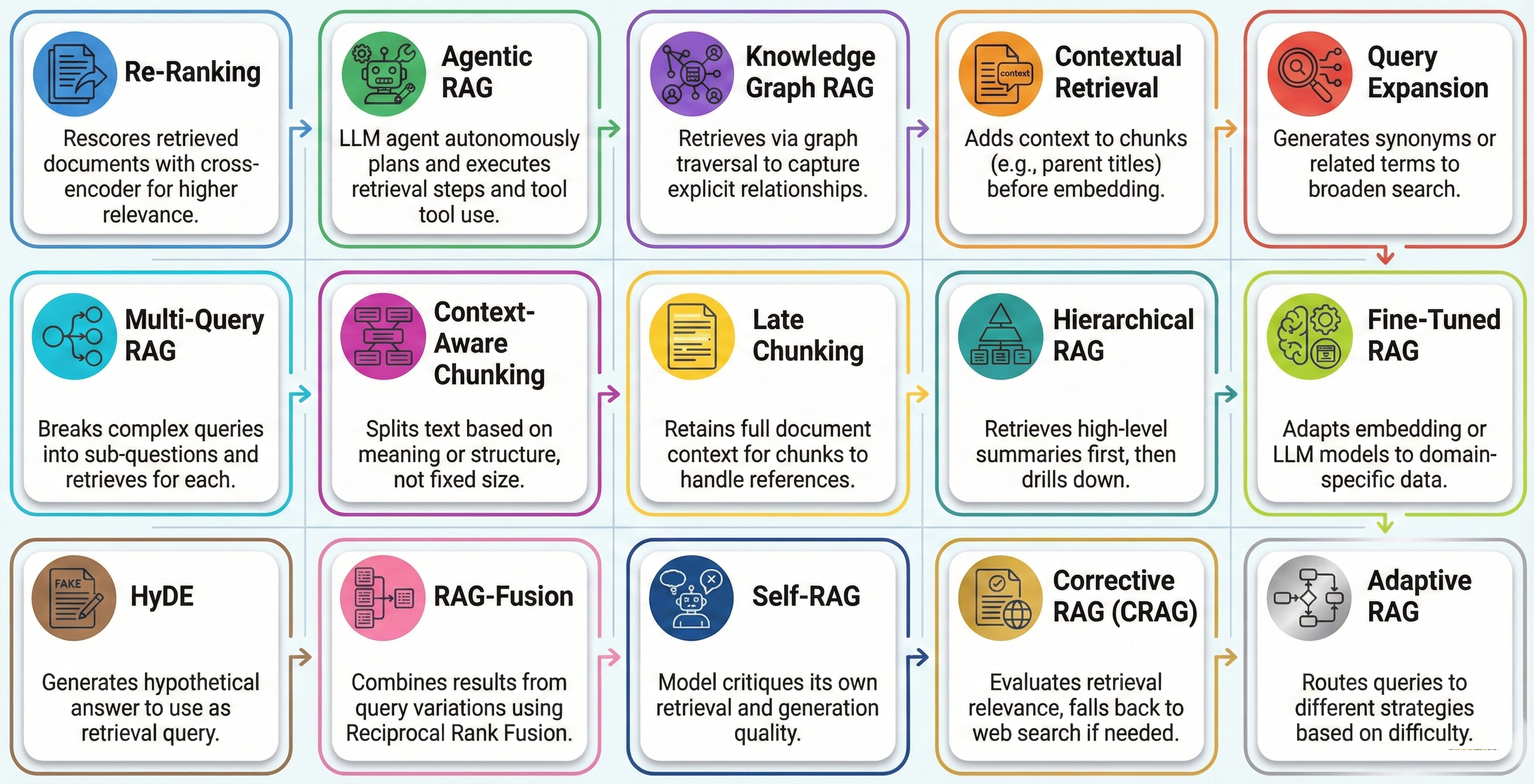
But not all RAG is created equal. Naive “retrieve-and-generate” pipelines break down when queries are ambiguous, documents are long, or the knowledge base is noisy. This repository explores 15 distinct RAG strategies, each addressing a specific weakness in the basic pattern.
Every strategy includes a Python implementation under src/ and an architecture diagram under architecture/.
Quick Start
git clone https://github.com/vchirrav/ml-rag-strategies.git
cd ml-rag-strategies
pip install -r requirements.txt
export OPENAI_API_KEY="your-api-key-here"   # Never hardcode API keys
See requirements.txt for the full dependency list. All samples read credentials from environment variables — never hardcode secrets.
The 15 Strategies
Re-Ranking
Use case: Customer Support
Combines fast vector search with a cross-encoder scoring pass to surface the most relevant results from an initial candidate set. The retriever casts a wide net, then the re-ranker applies fine-grained relevance scoring to reorder results before they reach the LLM.
Agentic RAG
Use case: Research Assistant
An LLM agent autonomously decides when and what to retrieve. Rather than always retrieving on every query, the agent reasons about whether retrieval is needed, formulates targeted queries, and can perform multi-step lookups with adaptive planning.
Knowledge Graph RAG
Use case: Medical Q&A
Structures documents as entity-relationship graphs and retrieves via graph traversal rather than vector similarity alone. Entities and their relationships are extracted during indexing, enabling multi-hop reasoning across connected concepts.
Contextual Retrieval
Use case: Legal Document Search
Prepends LLM-generated context summaries to each chunk before embedding. This preserves document-level meaning that would otherwise be lost during chunking, dramatically improving retrieval accuracy for context-dependent content.
Query Expansion
Use case: E-Commerce Search
Rewrites the user query into multiple phrasings and retrieves for each variant, then deduplicates results. This bridges the vocabulary gap between how users ask questions and how information is stored in the knowledge base.
Multi-Query RAG
Use case: Comparative Analysis
Decomposes complex questions into independent sub-questions, retrieves context for each sub-question separately, and synthesizes a unified answer. Ideal for questions that span multiple topics or require comparison.
Context-Aware Chunking
Use case: Technical Manuals
Splits documents along semantic boundaries (headings, paragraphs, sections) rather than fixed token counts. Preserves the logical structure of documents, ensuring each chunk contains a complete, coherent unit of information.
Late Chunking
Use case: Academic Papers
Processes full documents through the embedding model first, then splits the resulting token embeddings into chunks. Each chunk retains awareness of the full document context since embeddings were computed holistically before splitting.
Hierarchical RAG
Use case: Large Codebase Navigation
Uses two-level indexing: first retrieve high-level summaries to identify relevant documents, then drill into detailed chunks within those documents. Enables efficient coarse-to-fine retrieval over very large corpora.
Fine-Tuned RAG
Use case: Biomedical Literature
Fine-tunes the embedding model or the generation model on domain-specific question-answer pairs. Adapts the retrieval and generation components to the vocabulary, concepts, and reasoning patterns of a specific domain.
HyDE (Hypothetical Document Embeddings)
Use case: Vague Query Resolution
Generates a hypothetical answer to the query, then uses that answer as the retrieval query instead of the original question. By embedding a plausible answer rather than a short question, retrieval quality improves significantly for underspecified queries.
RAG-Fusion
Use case: Multi-Rephrase Combination
Generates multiple query variants, retrieves independently for each, and combines results using Reciprocal Rank Fusion (RRF). This reduces the impact of any single query formulation and produces more robust retrieval results.
Self-RAG
Use case: Adaptive Chatbot
The model self-reflects at each generation step, deciding whether retrieval is needed, evaluating the relevance of retrieved documents, and verifying that its response is properly grounded. Introduces learned reflection tokens for autonomous quality control.
Corrective RAG (CRAG)
Use case: Internal Wiki with Web Fallback
Grades retrieved documents for relevance and falls back to web search if the internal knowledge base returns insufficient results. Includes a knowledge refinement step that strips irrelevant content from retrieved passages before generation.
Adaptive RAG
Use case: Help Desk Query Routing
Classifies incoming query complexity and routes to the appropriate retrieval strategy: simple queries use direct retrieval, moderate queries use query expansion, and complex queries are decomposed into sub-questions. Optimizes cost and latency by matching strategy to need.
When to Use Which Strategy
Improving Retrieval Quality
Re-Ranking (post-retrieval scoring), Contextual Retrieval (chunk-level context), Late Chunking (holistic embeddings), Fine-Tuned RAG (domain adaptation)
Handling Complex Queries
Query Expansion (vocabulary gap), Multi-Query RAG (decomposition), HyDE (vague queries), RAG-Fusion (multi-rephrase RRF)
Scaling to Large Corpora
Hierarchical RAG (two-level indexing), Context-Aware Chunking (semantic splitting), Knowledge Graph RAG (entity-relationship traversal)
Self-Correcting & Adaptive Systems
Self-RAG (reflection tokens), Corrective RAG (web fallback), Adaptive RAG (complexity-based routing), Agentic RAG (autonomous retrieval decisions)
Security Considerations for RAG Systems
RAG pipelines introduce unique attack surfaces that traditional applications don't have. Every strategy in this repository follows defensive practices:
- No hardcoded secrets — All API keys are read from environment variables, never committed to source control
- Context grounding — Responses are grounded in retrieved content to prevent hallucination and reduce prompt injection risk
- No arbitrary code execution — None of the strategies execute dynamically generated code, eliminating code injection vectors
- Minimal dependencies — Only well-maintained, widely-used libraries are included to reduce supply chain risk
- Input validation — Review retrieved content before passing to the LLM to prevent indirect prompt injection attacks
Repository Structure
ml-rag-strategies/
├── README.md
├── RAG_LIBRARIES.md           # Companion guide to RAG libraries
├── requirements.txt           # Shared Python dependencies
├── architecture/              # SVG architecture diagrams
│   ├── 01_reranking.svg
│   ├── 02_agentic_rag.svg
│   ├── ...
│   └── 15_adaptive_rag.svg
└── src/                       # Python implementations
    ├── reranking/             # Strategy 01
    ├── agentic_rag/           # Strategy 02
    ├── knowledge_graph_rag/   # Strategy 03
    ├── contextual_retrieval/  # Strategy 04
    ├── query_expansion/       # Strategy 05
    ├── multi_query_rag/       # Strategy 06
    ├── context_aware_chunking/# Strategy 07
    ├── late_chunking/         # Strategy 08
    ├── hierarchical_rag/      # Strategy 09
    ├── fine_tuned_rag/        # Strategy 10
    ├── hyde_rag/              # Strategy 11
    ├── fusion_rag/            # Strategy 12
    ├── self_rag/              # Strategy 13
    ├── corrective_rag/        # Strategy 14
    └── adaptive_rag/          # Strategy 15
Also see RAG_LIBRARIES.md for a companion guide to the libraries and frameworks used across strategies.
Explore the Code
All 15 strategies are open-source with runnable implementations and architecture diagrams. Clone the repository, install dependencies, and start experimenting with RAG patterns.